GPSC Assistant Professor Syllabus 2026:- The GPSC Assistant Professor examination is a great opportunity for candidates who want to build a stable and respected career in teaching. However, one important thing to remember is that Gujarat Public Service Commission (GPSC) usually releases separate advertisements and syllabi for different subjects.
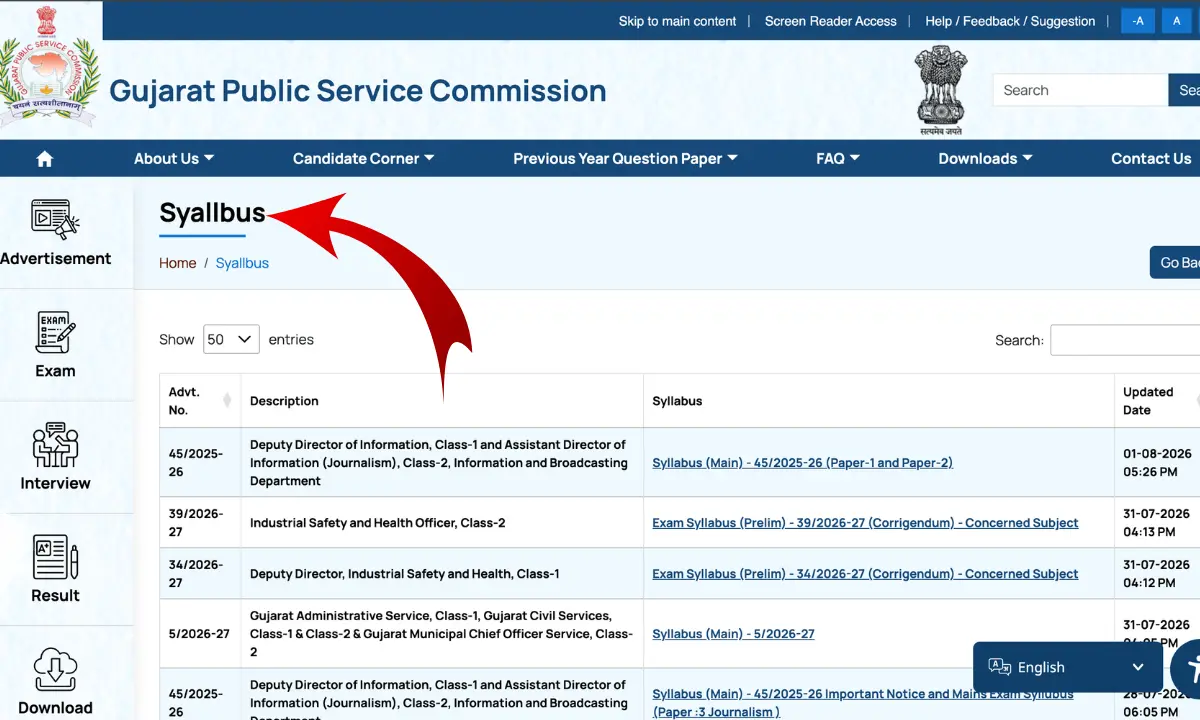
Therefore, the exact syllabus, vacancies, eligibility conditions and exam pattern may vary according to the subject and advertisement number. The official GPSC syllabus page lists separate Assistant Professor syllabi for subjects such as General Medicine, General Surgery, Paediatrics, Psychiatry, ENT, Ophthalmology and other specialisations.
This article explains the common structure of the GPSC Assistant Professor Syllabus 2026, important topics, exam pattern and a practical preparation strategy in simple language.
GPSC Assistant Professor Syllabus 2026 Overview
| Particular | Details |
|---|---|
| Exam name | GPSC Assistant Professor Recruitment Examination 2026 |
| Conducting body | Gujarat Public Service Commission |
| Post | Assistant Professor |
| Recruitment method | Subject-wise advertisement |
| Exam type | Objective-type written examination in many recruitment cycles |
| Main sections | General Studies and Concerned Subject |
| Duration | Usually around 3 hours, depending on the advertisement |
| Selection stages | Written examination and interview, wherever prescribed |
| Subject paper | Based on the concerned postgraduate or UGC-NET-level subject |
| Official website | gpsc.gujarat.gov.in |
Candidates should always download the syllabus PDF connected with their own advertisement number. A candidate applying for Assistant Professor in Computer Science may have a completely different subject paper from a candidate applying for Political Science, Zoology or a medical speciality.
GPSC Assistant Professor Exam Pattern 2026
In recent recruitment cycles, the written examination has generally included two broad parts: General Studies and the concerned subject. Some sources report a paper structure of 200 to 300 objective questions or marks, depending on the recruitment cycle and subject advertisement. Candidates should not rely only on a general exam pattern because GPSC may change the structure for different posts.
| Section | Main focus | Expected importance |
|---|---|---|
| Part A | General Studies, Gujarat knowledge, current affairs and mental ability | Common or partially common section |
| Part B | Concerned subject | Usually the most important section |
| Interview | Subject knowledge, teaching ability, research and personality | Applicable as per notification |
The exact number of questions, marks, negative marking, qualifying marks and interview weightage must be checked in the official notification. For example, recent Assistant Professor answer-key updates covered separate subject examinations in Politics, Computer Science and Zoology, with each paper containing 200 questions.
Part A: General Studies Syllabus
The General Studies section tests whether the candidate understands Gujarat, India and important national and international developments. Even candidates with strong subject knowledge should not ignore this section because it can make a significant difference in the final score.
Important General Studies Topics
| Subject area | Important topics |
|---|---|
| Current Affairs | National, international and Gujarat-related events, government schemes, awards, sports and important appointments |
| Indian History | Ancient, medieval and modern Indian history, freedom movement and important personalities |
| Gujarat History | Major historical events, rulers, movements and contribution of Gujarat to India’s development |
| Culture and Heritage | Gujarati literature, folk traditions, festivals, art, architecture, music and cultural institutions |
| Indian Polity | Constitution, Fundamental Rights, Directive Principles, Parliament, Supreme Court, elections and federalism |
| Gujarat Administration | State government, local self-government, Panchayati Raj and important state-level institutions |
| Geography | Physical geography of India and Gujarat, rivers, climate, agriculture, minerals and industries |
| Indian Economy | Growth, inflation, poverty, employment, banking, budgeting and economic planning |
| Gujarat Economy | Agriculture, ports, industries, infrastructure, tourism and major development projects |
| General Science | Basic concepts of physics, chemistry, biology, health and environmental science |
| Science and Technology | Space, information technology, biotechnology, cyber security and digital services |
| Mental Ability | Reasoning, data interpretation, basic numerical ability and analytical thinking |
| Education Awareness | Higher education, UGC-related developments, NEP 2020, teaching methods and academic reforms |
For Gujarat-specific preparation, candidates should focus on the state’s geography, economy, history, cultural heritage and current government initiatives. Reading current affairs regularly is more effective than trying to memorise everything during the final week.
Part B: Concerned Subject Syllabus
The concerned subject is the core part of the GPSC Assistant Professor examination. It generally covers postgraduate-level concepts and may follow the depth and broad structure of the UGC-NET syllabus for the relevant discipline.
Candidates should prepare the subject using:
- Postgraduate-level textbooks.
- UGC-NET or SET syllabus.
- University notes and standard reference books.
- Previous-year question papers.
- Research methodology and teaching-related concepts, wherever included.
- Recent developments in the relevant discipline.
Examples of Subject-Wise Topics
| Subject | Important areas to prepare |
|---|---|
| Political Science | Political theory, Indian government and politics, comparative politics, international relations, public administration and political thinkers |
| Computer Science | Data structures, algorithms, database management systems, operating systems, computer networks, computer architecture, theory of computation and software engineering |
| Zoology | Cell biology, genetics, evolution, ecology, animal physiology, developmental biology, taxonomy and molecular biology |
| Geography | Physical geography, human geography, economic geography, Indian geography, Gujarat geography, environmental geography, GIS and remote sensing |
| Sociology | Sociological thinkers, research methodology, Indian society, social change, social stratification, rural and urban sociology |
| Commerce | Accounting, business management, economics, financial management, marketing, statistics, taxation and human resource management |
| Economics | Microeconomics, macroeconomics, public finance, Indian economy, statistics, development economics and international economics |
| English | British literature, Indian writing in English, literary theory, criticism, language studies, phonetics and research methodology |
| History | Ancient, medieval and modern Indian history, world history, historiography, culture and regional history |
| Medical subjects | Basic medical sciences, clinical medicine, diagnosis, treatment, recent developments and speciality-specific topics |
This table is only a broad guide. The actual topics may be different for each post, particularly in medical, engineering, science and professional subjects. Always compare these topics with the PDF issued for your specific GPSC advertisement.
How to Download the Official Syllabus
Candidates can follow these simple steps to download the correct syllabus:
- Visit the official GPSC website.
- Open the syllabus or advertisement section.
- Search for “Assistant Professor” and the relevant subject.
- Note the advertisement number carefully.
- Download the syllabus PDF.
- Check the exam scheme, marks, duration and instructions.
- Keep a printed or saved copy for preparation.
The official GPSC listing shows that Assistant Professor recruitment is organised through separate subject-specific advertisements rather than one single universal syllabus.
GPSC Assistant Professor Preparation Strategy
Preparing for this examination becomes easier when the syllabus is divided into manageable sections. Instead of studying randomly, candidates should create a weekly plan that gives priority to the concerned subject while also reserving time for General Studies.
A Practical Study Plan
| Preparation period | Main target |
|---|---|
| First month | Understand the syllabus, collect books and revise basic concepts |
| Second month | Complete important subject units and begin Gujarat General Studies |
| Third month | Solve previous papers, practise MCQs and revise current affairs |
| Final weeks | Take full-length mock tests and revise short notes |
A good daily routine may include two or three study sessions for the concerned subject, one session for General Studies and a short period for current affairs. Candidates should also maintain a notebook for important facts, difficult concepts, government schemes, formulas and frequently repeated questions.
Important links
| Download Official Syllabus PDF (Subject-Wise) | click here |
| Official Website | click here |
| notification 24 jobs | click here |
Frequently Asked Questions
Is the GPSC Assistant Professor Syllabus the same for every subject?
No. The General Studies portion may be similar, but the concerned-subject syllabus changes according to the post and discipline.
Is the 2026 notification common for all Assistant Professor posts?
Usually, GPSC releases separate advertisements for different subjects and categories. Candidates must check the official website for the advertisement related to their subject.
Is the subject syllabus similar to UGC NET?
In many subjects, the level and broad coverage are comparable to UGC-NET or SET preparation. However, candidates must follow the exact GPSC syllabus PDF for final preparation.
Is there negative marking?
Negative marking, if applicable, is decided in the specific examination notification. Candidates should check the official advertisement instead of assuming the rule.
How can I prepare for General Studies?
Focus on Gujarat history, culture, geography, economy, polity, current affairs, Indian Constitution, science and reasoning. Make short notes and revise them regularly.